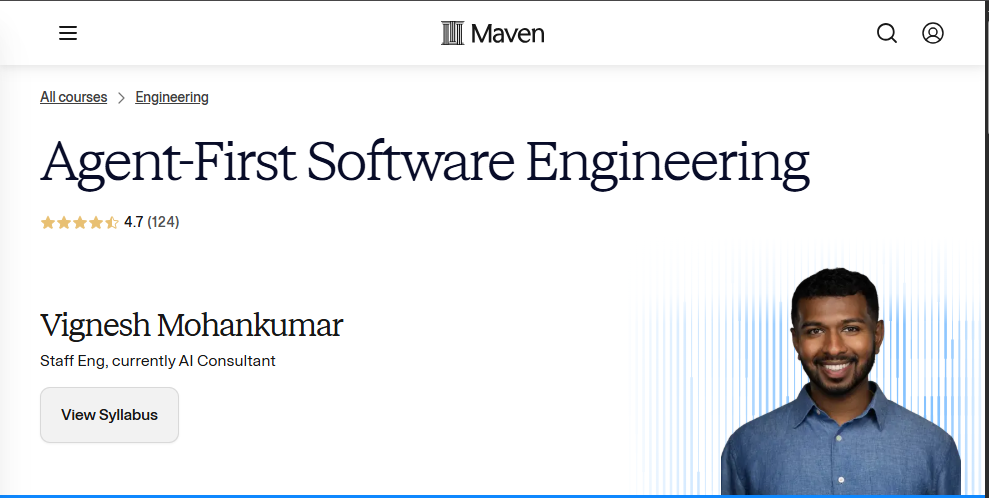
Vignesh Mohankumar – Agent-First Software Engineering
$499.00 Original price was: $499.00.$60.00Current price is: $60.00.

Vignesh Mohankumar – Agent-First Software Engineering
Artificial Intelligence is no longer just a feature inside software. It is becoming the core engine that drives how modern systems are designed, built, and scaled. Traditional software engineering focuses on writing code to execute predefined logic. But today, developers are shifting toward something more powerful — building intelligent agents that can reason, act, and adapt.
That’s where Vignesh Mohankumar – Agent-First Software Engineering stands out. Instead of teaching AI as an add-on, this framework introduces a completely new mindset: build with agents at the center, not at the edges.
This isn’t about simple chatbot integrations. It’s about designing software systems where autonomous AI agents handle workflows, make decisions, coordinate tasks, and continuously improve performance.
Let’s break down what this approach truly means and why it is shaping the future of development.
What Is Agent-First Software Engineering?
Agent-First Software Engineering is a development philosophy where AI agents are treated as primary system components rather than secondary tools.
In traditional architecture:
Frontend interacts with backend
Backend interacts with database
Business logic runs through static code
In agent-first architecture:
AI agents interpret goals
Agents break tasks into subtasks
Agents use tools and APIs
Agents coordinate with other agents
Agents adapt based on results
This shift transforms software from rule-based automation to intelligent orchestration.
Instead of writing 500 lines of hard-coded business logic, developers design agent frameworks that:
Understand user intent
Decide which tools to call
Validate outputs
Retry when necessary
Learn from patterns
This is not just automation. This is autonomous system design.
Why Agent-Based Systems Are the Future
The software industry is evolving rapidly due to:
Large Language Models (LLMs)
Tool-using AI systems
Multi-agent collaboration frameworks
API-driven ecosystems
Rapid prototyping with AI copilots
Traditional development cycles are slow when logic constantly changes. Agents reduce rigidity. They allow systems to evolve without rewriting massive amounts of code.
Key advantages include:
1. Adaptability
Agents can interpret instructions dynamically instead of relying on rigid conditional statements.
2. Scalability
Multi-agent systems distribute workload efficiently across specialized agents.
3. Faster Development
Developers define goals and tools rather than every edge case.
4. Intelligent Automation
Workflows become context-aware instead of rule-dependent.
This is why modern AI-native startups are adopting agent-centric architectures.
Core Concepts Covered in the Framework
To master agent-first engineering, several core components must be understood deeply.
1. AI Agent Design
An AI agent consists of:
A reasoning engine (LLM)
Memory system
Tool access layer
Goal planning module
Feedback loop
Designing agents requires clarity in:
Prompt structuring
Tool integration
Output validation
Error handling
A well-designed agent behaves like a junior developer that can:
Read documentation
Use APIs
Execute workflows
Debug errors
2. Tool Integration & Function Calling
Agents become powerful when connected to:
Databases
External APIs
Payment gateways
File systems
Search engines
Instead of returning plain text, agents:
Trigger structured functions
Pass arguments
Interpret results
Make follow-up decisions
This transforms them from chatbots into workflow operators.
3. Multi-Agent Collaboration
One agent can do a lot.
Multiple agents can build entire systems.
Multi-agent frameworks allow:
Task decomposition
Parallel processing
Role specialization
Conflict resolution
For example:
Research Agent gathers data
Analysis Agent processes data
Execution Agent performs action
Review Agent validates output
This layered structure mimics real-world team dynamics.
4. Memory & Context Management
Stateless systems are limited.
Agent-first architecture introduces:
Short-term memory (session context)
Long-term memory (persistent data)
Retrieval-augmented generation (RAG)
This ensures agents:
Remember user preferences
Track previous actions
Improve recommendations
Maintain continuity
Memory design is one of the most critical components of scalable AI systems.
5. Evaluation & Guardrails
Autonomous systems must be reliable.
Key areas include:
Output validation
Hallucination detection
Retry logic
Human-in-the-loop checkpoints
Logging & observability
Without guardrails, agent systems become unpredictable.
Proper evaluation ensures:
Stability
Accuracy
Compliance
Performance optimization
Real-World Applications
Agent-first engineering is already transforming industries.
SaaS Automation Platforms
AI agents handle onboarding, customer support, CRM updates, and data enrichment automatically.
E-Commerce Systems
Agents:
Monitor pricing
Optimize inventory
Generate product descriptions
Personalize recommendations
Marketing Automation
Multi-agent workflows manage:
Content creation
SEO optimization
Ad campaign testing
Performance analysis
Developer Tools
Agents:
Generate code
Refactor modules
Write documentation
Perform QA testing
The future developer is not just a coder — but a system architect of intelligent agents.
How This Approach Changes Software Architecture
Traditional architecture:
Client → Server → Logic → Database
Agent-first architecture:
User Goal → Planner Agent → Tool Agents → Validator Agent → Memory → Output
This shift introduces:
Modular intelligence
Reusable agent roles
Dynamic task allocation
Continuous improvement loops
Systems become more human-like in reasoning but machine-efficient in execution.
Skills You Develop
Mastering this framework helps developers gain:
AI system design thinking
Prompt engineering at scale
Tool orchestration
Multi-agent architecture design
Observability and evaluation methods
AI workflow automation
LLM optimization strategies
These are high-demand skills in AI startups and tech companies building next-generation products.
Difference Between Prompt Engineering and Agent Engineering
Prompt engineering:
Single request-response interaction
Mostly stateless
Limited workflow execution
Agent engineering:
Multi-step reasoning
Tool usage
Memory persistence
Error recovery
Goal tracking
Agent engineering is significantly more complex and more powerful.
It moves from “asking AI a question” to “building AI-driven systems.”
Common Mistakes in Agent Development
To build high-quality agent systems, avoid:
Over-Reliance on Prompts
Architecture matters more than clever wording.
Ignoring Error Handling
Agents must gracefully handle failed tool calls.
No Evaluation Layer
Without validation, output reliability drops.
Weak Memory Design
Context fragmentation reduces intelligence quality.
Lack of Observability
Logging and traceability are critical in production systems.
The Future of Agent-First Development
The next evolution includes:
Autonomous SaaS businesses
Self-optimizing marketing pipelines
AI-powered research labs
Agent-driven financial modeling
Personalized AI assistants for enterprises
Developers who understand agent-first engineering will shape this transformation.
Companies are actively seeking engineers who can:
Design AI workflows
Implement tool-calling systems
Optimize LLM performance
Build scalable agent infrastructure
This is no longer experimental technology. It is becoming production reality.
Who Should Learn Agent-First Software Engineering?
This approach is ideal for:
Software developers transitioning into AI
Startup founders building AI-native products
Automation engineers
Product managers in AI companies
Technical entrepreneurs
Backend engineers expanding skillsets
If you want to stay relevant in the next 5–10 years of software innovation, understanding this paradigm is critical.
Why This Methodology Matters Now
The speed of AI innovation is accelerating. Static systems cannot compete with adaptive systems.
Agent-first engineering allows:
Faster iteration
Reduced manual operations
Intelligent automation
Continuous optimization
It shifts the developer’s role from writing rigid code to designing intelligent ecosystems.
This mindset will define modern software engineering.
Final Thoughts
Vignesh Mohankumar – Agent-First Software Engineering represents a shift in how we conceptualize and build software systems. Instead of treating AI as an add-on feature, this methodology places intelligent agents at the heart of architecture.
The result is software that:
Thinks
Plans
Executes
Learns
Improves
As AI becomes foundational across industries, agent-first systems will replace many traditional workflows.
The developers who master this approach will not just build apps — they will build autonomous digital workforces.
If you are serious about future-proofing your technical career and building intelligent systems that scale, understanding agent-first software engineering is not optional — it is essential.